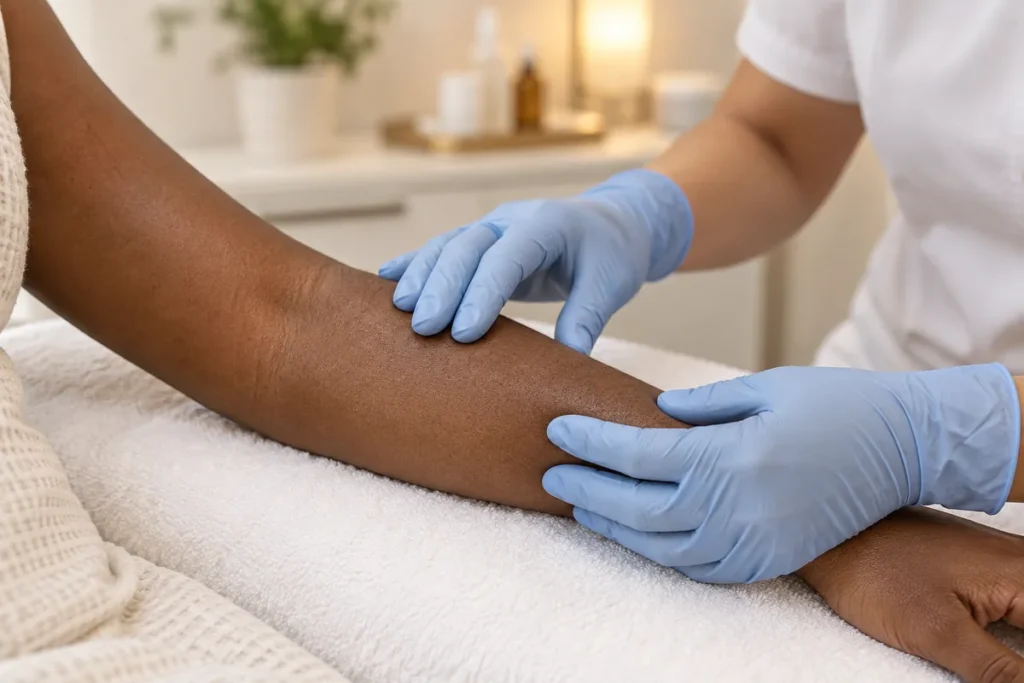
Lightbox Laser Clinic offers tailored treatments for long-term hair reduction across the face and body. Our advanced multi-wavelength technology treats a wide range of skin tones and hair types, with every plan beginning with a professional consultation and patch test.
Laser Hair Removal is a safe and effective way to achieve long-term hair reduction on the face and body using advanced laser technology.
It works by using concentrated light energy that is absorbed by the pigment (melanin) in the hair. This light energy converts into heat, which travels down the hair shaft and gently damages the follicle responsible for producing new hair. Over time, this significantly slows down regrowth, leaving the hair finer, lighter, and much less noticeable.
For the treatment to be successful, the hair follicle needs to be in the active growth phase of its lifecycle (known as the anagen phase). Hair grows in cycles, and not all follicles are active at the same time as some are growing, some are resting, and some are shedding.
Because of this, multiple sessions are needed to ensure each follicle is treated at the right moment, when in active growth. This is also why treatments are spaced several weeks apart, allowing us to gradually target every follicle and achieve the best possible long-term results.
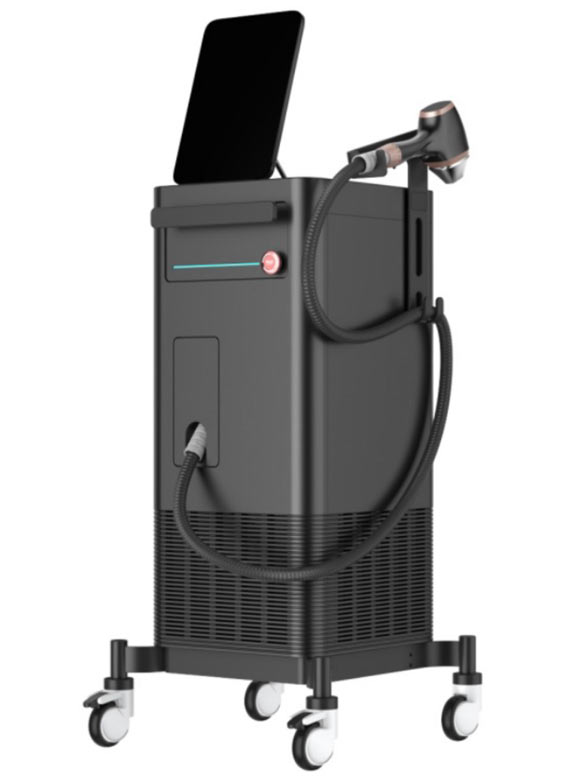
We use advanced Quantum laser technology to deliver safe, effective and long-lasting hair reduction treatments. The system targets the hair follicle with precise laser energy while helping to protect the surrounding skin, making treatments suitable for a wide range of skin types and treatment areas.
Quantum laser technology is designed to provide fast, comfortable treatments with excellent results across areas including the face, legs, underarms and bikini line.
Please note:
Before we can proceed with treatment, you will need a consultation to devise a plan that works for you as well as a patch test to ensure you have no adverse reaction from the laser. Required at least 7 days before treatment for tattoo removal and 48 hours before laser hair removal.
Our most popular treatments. Every course begins with a consultation and patch test, from £15.
| Treatment | 1 session | Block of 6 |
|---|---|---|
| Upper lip | £40 | £200 |
| Underarms | £65 | £325 |
| Bikini line | £70 | £350 |
| Full face | £95 | £475 |
| Half leg | £90 | £450 |
| Full leg | £140 | £700 |
| Full body | £500 | £2,500 |
See the full laser hair removal price list for every treatment area. Travelling from further afield? We also see clients for laser hair removal in Falmouth.
Laser hair removal is much less effective on blonde, grey, or red hair. This is because laser technology works by targeting melanin (pigment) within the hair follicle. Darker hair contains more melanin, which absorbs the laser’s light energy and converts it into heat. That heat is what damages the follicle and reduces future hair growth. The stronger the pigment, the easier it is for the laser to “see” and treat the hair effectively.
Blonde, grey, and red hairs contain very little melanin, which makes it much harder for the laser to detect them. Without enough pigment to absorb the heat, the light energy cannot properly target and permanently disable the follicle. In fact, lighter hair can reflect or disperse the laser energy rather than absorb it, meaning results are often minimal or inconsistent. While some modern laser systems may offer limited improvement for certain lighter hairs, outcomes are generally not as reliable as they are with darker hair.
You may start noticing hair shedding around 1-3 weeks after your treatment. It can sometimes look like the hair is still growing, but don’t panic! What’s actually happening is that the treated hairs are being gently pushed out of the follicle. It’s all part of the process. You might even notice the hairs feel a little “loose” or fall away when you exfoliate or shower, that’s a great sign the treatment is working.
Visible reduction typically becomes more noticeable after two to three sessions. With each appointment, more follicles are successfully treated during their active growth phase, which means hair gradually grows back finer, lighter, and much more sparse. It’s a gradual process, but well worth the wait!
To get the best results from your treatment, preparation is key. It’s really important that you shave the treatment area around 24 hours before your appointment. This allows the laser to focus its energy directly into the hair follicle beneath the skin, rather than burning surface hair. Waxing, plucking, threading, or using hair removal creams should not be attempted for at least 4 weeks before treatment, as the laser needs the hair root intact and the hair in the growth phase for the laser to effectively target and disable it.
Another important part of preparing for treatment is to avoid sun exposure, sunbeds, and fake tan before your session. This is because tanned skin can increase sensitivity and may affect how safely the laser can be used. Preparation on the day of your appointment is also key. Your skin, in and around the treatment area, should be clean and free from body lotions, oils, deodorant and makeup.
After your laser hair removal session, your skin may feel slightly warm and sensitive and it may look a bit red. This is completely normal and usually settles within a few hours. To help your skin recover comfortably, make sure you avoid anything thing that will heat the skin such as hot baths, saunas and steam rooms, avoid exercise also for at least 24 hours.
You should also minimise direct sun exposure and apply a minimum SPF 30 to protect the skin. You should avoid putting any harsh products on your skin such as fake tan, exfoliating products and retinols for a few days, as these can cause unnecessary sensitivity. Just stick to gentle cleansers, soothing moisturisers, and cool showers. Treat your skin kindly and always follow the aftercare advice.
Laser hair removal is usually much more comfortable than people expect. Most clients describe the sensation as a quick, warm flick against the skin, similar to a tiny elastic band pinging against the skin. It’s a quick treatment, therefore the discomfort is short lived and modern laser systems include built-in cooling technology to keep the skin protected and comfortable throughout the treatment.
There are some areas which are more uncomfortable than others however, as some areas of the body can feel slightly more sensitive. This is generally where the hair is thinker (such as the bikini line) or the skin is thinner (such and the upper lip). Many clients tell us it’s far less painful than waxing, but without the sticky mess and with permanent results.
Whilst laser hair removal can be effective in managing hormonal hair growth, it’s not a permanent solution for hair removal. Conditions such as PCOS, thyroid imbalances, menopause, or other hormonal fluctuations can stimulate ongoing hair growth. Laser can successfully reduce and weaken existing hairs, making them grow back finer, lighter, and much slower over time.
However, because hormonal hair can continue to be triggered internally, additional sessions and most likely, maintenance sessions will be needed to keep results consistent. The good news is that even with hormonal hair growth, laser significantly reduces thickness and density, making hair much easier to manage. During your consultation, we can assess your individual situation and create a treatment plan that sets realistic expectations while still delivering noticeable, confidence-boosting results.
We do not recommend laser hair removal during pregnancy. There is a couple of reasons for this. Firstly, whilst there is no evidence showing that laser treatment is harmful to you or your baby, there also hasn’t been enough research to say it’s completely safe. For that reason, we will not carry out the treatment until after you’ve given birth.
There is also another significant reason why you should not have laser hair removal during pregnancy and this is due to your hormones. Pregnancy hormones can affect how your skin reacts to the treatment (such as increase sensitivity and changes in skin pigmentation). It can also affect how your hair grows, which has an impact on the overall effectiveness of the treatment. Waiting until after pregnancy and breastfeeding, when your hormones have settled, and your skin is back to normal, will mean achieving more effective results.